
If you have a novel service or product, you face the additional challenge of reaching an audience. If you’ve been toiling over your GTM (go-to-market) strategy, you will soon learn the ugly reality: people struggle to embrace products or services, even ones that hold clear value for them. You can present the perfect solution to a problem they have and it just doesn’t resonate.
You’re missing something simple.
No one trusts you, your company, or your claims. Any new relationships start at a default state of disbelief, maybe suspicion.
People turn to trusted networks, individuals, and tribes to validate new information. Referrals don’t just apply to new jobs or sales, we run all new information through a kind of referral system—a hidden communications structure made up of trust channels.
I see products, services, and companies lose to inferior products due to a lack of distribution. My goal in writing this deep dive is to help you build a GTM strategy through efficient trust channels that gives you a fighting chance in the noisy marketplace of ideas.
Who are you?
My name is Justin Brady. I build strong GTM foundations for novel startups like Soar.com, Roboflow, Martin Bionics, and established iconic brands like The Global Peter Drucker Forum and SHRM. I’ve worked with the founder of Ancestry.com, Paul Allen and Pres. Clinton and Mayor Bloomberg’s political strategist, Mike Berland. I wrote for The Washington Post, Harvard Business Review, The Wall Street Journal, interviewed Presidential candidates for iHeart Radio, and I’ve had A-List CEOs, academics, and authors on my podcast.
Why customers ignore you
Everyone who built a legendary company tapped into trust channels. They ran a PR campaign, had connected friends, had access to an existing platform, or maybe an influential person opened doors. They had pre-built distribution, even if they aren’t aware.
These individuals will tell you the secret to their success was the strength of their idea, value of their product, or “just being consistent.” And while those are required, it’s one of two components: Product market fit AND distribution.
Affirmed by folks with pre-built distribution, CEOs, founders, marketers, and entrepreneurs beat their head against a wall, assuming great ideas pull in customers like a magnet. David Burkus calls this The Mousetrap Myth. The world will not beat a path to your door when you build a better mousetrap.
Great ideas, products and services won’t attract an audience. This is the biggest misunderstanding in founder-land. Communication and earning immediate trust are paramount in building a strong GTM foundation and strategy.
Need an example?
Idea blindness: The Wright Brothers
When human flight was achieved, any reasonable person would assume wall-to-wall media coverage would accompany the breakthrough. In that case, Orville and Wilbur Wright should have been a household name, but not until three years later did The New York Times write a single word about them.
As of 1908, nearly 5 years after the achievement, few people knew human flight had been achieved, according to Rita McGrath in Seeing Around Corners. You may believe word traveled slow at that time, but you’d be wrong.
On July 7th in 1907, a sermon from Rev. Father Michael G. Esper in St. Joseph’s Catholic Church about teddy bears harming the human race made national news in 24 hours.
Here’s the tragic truth: having the best idea or product in the world doesn’t matter. What matters is how you communicate that idea and what trust channels you utilize.
The best idea, product, or service in the world doesn’t matter. What matters is how you communicate that idea.
Creator bias robs you of objectivity
I work with inventive people often. Some have bootstrapped from nothing. Others have 20M Series A raises from top VCs. Some have half-billion dollar exits. Some are CEOs or CMOs of large iconic brands. All struggle to connect what they do to those who benefit. It’s tough for them to see the GTM communication breakdown.
They suffer from a kind of creator baby bias in the same way a parent can’t see past their love for their own baby. That’s not bad—love for your baby drives you! You know the work that has gone into creating the idea. You know what makes it unique. You’re a believer. That’s to be expected, but the world doesn’t care… yet.
Getting the word out is challenging. In addition to your bias, there’s more noise and trust is difficult to earn. You’re stuck in between a hard and a hard place.
The State of Trust
Media trust is hitting record lows. Viewership for national shows is down. Social media is noisy and polarizing. Disinformation is everywhere. Videos are deep faked. A full Joe Rogan podcast interview can be easily AI-generated. Soon, political candidates will flood the internet with fake damaging content to hide real damaging content—the process of content obfuscation. Despite facing record loneliness, dating apps are stalling.
People are circling the intellectual wagons by tightening their sources for information. Less-trustworthy channels that are not iron-clad are being abandoned. People are turning to local communities and questioning national communities.
The most direct path for you to get an idea into the minds and hearts of your customer is to use their trust channels. Trust and a personal referral have always been the gold standard, scale and global reach is what has changed.
Trust channels defined
Trust channels are the people and networks that surround us, keeping us informed. Everyone on the planet is surrounded by not one, not two, but hundreds of trust channels. A trust channel could be a podcast, but it could be your bartender too. You and I can’t possibly vet every source of new information, so we take shortcuts. Trust channels are those shortcuts.
Let me give you a really simplified example.
You arrive at a party and the host immediately embraces you, telling everyone in the room, “You all have to meet <your name>; they’re the best <what you do>!” In a few seconds, you gained instant trust and credibility that would have typically taken decades to build—the host’s trust immediately transferred to you. The host was a key trust channel to a new audience.
This idea scales to an innumerable degree. This is what trust channels are all about. By understanding them, you gain near-instant credibility and idea adoption with massive audiences. Without trust channels, your idea dies. With them, your idea thrives.
Understanding trust channels and how to communicate effectively, should be the cornerstone of your GTM strategy.
Examples of trust channels
Relationships and trust have always been the key component to any sale. That will never change. But the trust channel change every year as our world invents new methods of communication.
As of June 2024, The Wall Street Journal (WSJ) has built a large trust channel of over 4.3 million subscribers. For this reason, PR people have historically relied on media as a trust channel.
Another trust channel that perhaps isn’t top of mind is Marques Brownlee. Better known as MKBHD on YouTube, Brownlee has amassed over 20 million subscribers absolutely crushing WSJ with a fraction of the budget. And Brownlee has developed only a small trust channel when compared to Jimmy Donaldson, known as Mr. Beast. The King of YouTube has 480M subscribers as of writing this. (I keep updating this number!)
Trust channels aren’t just limited to online media. They can be events like SXSW. The event brought together 270,000 people during their 2022 hybrid event.
Podcasts like The Psychology Podcast are significant trust channels. According to data analytics company SEM Rush, 20% of people say they’ve bought something because their favorite host endorsed it.
Radio has historically been an effective trust channel. According to NPR and Edison Research, “Almost half of all AM/FM radio listeners (46%) say they have considered a new company, product, or service after hearing an ad on the radio.” I had a live show with iHeart Radio for three years where I hosted 6 Presidential Candidates in the studio among others. If I endorsed a product over the air, the impact was significant. (We got a complaint from a bakery in Pella when we talked about their cakes. They called us to tell us to stop. True story.)
Trust channels aren’t limited to media, events, magazines, TV, podcasts, and digital streaming. A local VFW Post, book clubs, chiropractors, doctors, and local service organizations are often overlooked trust channels—stick with me.
When promoting a local company, a friend of mine found the most effective strategy to be simply hitting local events as a speaker, maximizing face-to-face interactions. At one event, attended by only 10 people he received 200 web hits amounting and a 2000% conversion rate. Compare that to a 0.3% – 0.5% conversion rate of digital ads.
Trust channels can also be locations, towns, or countries as well. If you meet someone from your hometown or country while traveling, have you noticed an immediate bond? Oddly, you trust them more than those around you. Although geography is not as effective as individual relationships, it most certainly is a trust channel. Axios has grown rapidly across the country pulling that very lever.
As larger newspapers continue to suffer subscriber decreases, Axios hit one million subscribers by focusing on local content.
Savvy brands are abandoning national influencers (or nonfluencers) in favor of local “influencers” with much smaller followings but strong high-trust networks. Some folks call them micro-influencers.
Startup Clayton Farms, a purveyor of pesticide-free greens, utilizes a local in-person trust channel approach—door knocking! As a tech company, it would make sense they’d focus on digital growth channels, Google Ads or geo-targeting but they opt to meet their new neighbors face-to-face when they build a new greenhouse in their region. CEO Clayton Mooney credits these in-person efforts for their rapid growth—he knows face-to-face introductions are powerful despite them being harder to qualify.
Building your GTM Foundation to use Trust Channels
There is no default tactic that works for every brand, but there is a North star that builds a proper GTM Foundation no matter who you are, and no matter what audience you serve.
Your GTM foundation in 3 steps:
1) Identify your purpose
2) Align messaging
3) Utilize your trust channels.
1. Identify your Purpose
Creating a strong GTM foundation starts by understanding your purpose. It requires taking a few steps back, and for good reason.
Identifying your company purpose reveals your total addressable market (TAM), customer values, ideal customer profile (ICP), and key data to position your company or product. Your purpose also serves communication cornerstone all sales and marketing reference in outbound communication.
CEOs and founders creating novel products or services are often so focused on solving their customers problem, they forget how lost they are. For this reason, they struggle to communicate with their audience, resulting in frustration for themselves.
In client onboarding, it takes me less than 1 hour to discover conflicting language amongst the leadership team. In many cases they aren’t aligned on the company’s reason for existing—their purpose.
This struggle to clearly communicate purpose to investors, stakeholders, and customers is a undertow drag on momentum—you may see symptoms.
- Your contacts introduce you incorrectly to colleagues.
- You struggle to consistently communicate what you do.
- You hear people ask questions that aren’t related to what you do.
- You hear people compare you to other companies that aren’t the same.
- You constantly change messaging based on audience.
Before developing a foundational GTM strategy around trust channels, I’d sit on calls with clients and hear them struggle to speak to investors, journalists and partners. I could hear what they were trying to communicate, because I had fully synthesized their brand value but they kept falling short.
This drag on momentum results in ballooning marketing costs and no data into why some strategies worked and others failed.
Start with Audience
Understanding your purpose starts with obsessing over your audience. Spend as much face-time with them as possible. The goal is to understand what drives them. There’s no formal process here, just spend as much time with your target audience as possible. Get to know their problems. Seek to understand them. Don’t sell to them.
You’ll make mistakes and that’s ok. You’ll talk to people who you considered an ideal customer, but are far from it. You’ll discover folks who are your ideal audience but weren’t top on your list. That’s ok.
In his newest book, What A Unicorn Knows, Matthew E. May recounts the story of how Toyota broke into the US Market with their new Lexus brand. After a failed first attempt to gain traction partnering with GM they refined their process of identifying the customer. Toyota decided to maximize face-to-face exposure with US buyers. May explains this Toyota design thinking practice, known as Genchi Genbutsu, or “go look, go see” in Japanese, was the differentiator.
The team spent months fully immersing themselves into the US luxury lifestyle. They rented nice cars, nice condos, stayed in luxury hotels, spent time in luxury venues, and ate at the best restaurants. The launch was successful, and Toyota’s Lexus brand quickly became the most popular American luxury brand. They “out-listened” their competitors.
Understanding your audience and their values requires speaking in their voice. If you feel lost and unsure of who your audience and their values, you’re not alone. Most marketers are poor at this explains David Allison, the world’s leading expert on values and author of The Death of Demographics.
Allison tells a great story about his early career as a condo tower marketer. His team built an extensive demographic profile of their ideal customer: Bob and Sally. They consistently sold out condo buildings, but one truth bothered him: the Bob and Sally demographic only made up 10% of their buyers.
“The ten percent who looked like Bob and Sally, they were very obviously similar on the outside. But actually, everybody in the room was similar—I was just looking at the wrong glasses.” Allison said to me in an interview. “Something I had said or done in the marketing had triggered some values for this group of people and that’s why they were all there. They were identical to each other valuegrahpically even though they were disparate and unlike from a demographic perspective.”
Allison would go on to create the world’s first valuegraphics data set.
Creators find themselves in this same position and because of this have no idea how to replicate their own success. Allison later discovered while his audience may not have aligned demographically, their values were very much aligned.
To get to your purpose there are two questions you to answer. What’s our peak, and what path will we take to get there?
This isn’t a crunchy granola, spiritual exercise. The way you communicate to people about your company should be the same for all vendors, customers, employees and investors. Finding your purpose builds a messaging foundation for every stakeholder, therefore making your GTM efforts clean, consistent and simple.
Purpose Step 1: Define your peak
Your “peak” is the change you want to see in the world without you in it. A proper peak statement doesn’t involve you, it’s the legacy you will have left behind.
Once your company has achieved everything you sent out to accomplish, what does the future look like? For a climbing gear company it might be “Conquering the toughest summit.”
Your peak is your vision. Documenting it transforms intuition into a reality all stakeholders can follow.
Purpose Step 2: Define your path
Defining the path is next. This clearly defines how you, your team, and all stakeholders will make it to your peak. This statement involves your brand. For the climbing company, their path might be “Creating zero-fail gear to handle the hardest climbs.”
Your path is a clear mission. It shows stakeholders how you plan on arriving at your peak.
When all stakeholders, including leadership, employees, customers, investors, and coworkers understand and communicate your purpose, messaging becomes effortless, and all stakeholders get it.
There are no questions regarding what you stand for and the goals you envision for the company. Vendors communicate your purpose to other vendors. Employees communicate your purpose to their network. And customers can communicate with customers by spreading your message.
Less time is spent and wasted on poor suggestions for new products or new marketing strategies. No time is lost in miscommunication about your product or service. All communication energy is focused on your objective.
To achieve this, messaging needs to be fully rolled out and clarified both internally and externally. Your purpose is your guide here, if a page on your website doesn’t align with the purpose, it’s wrong.
2. Message and Story
Consistent messaging solidifies your purpose internally and externally across the entire organization. When all stakeholders like customers, investors, employees, and leaders speak a common language, it lowers friction as they communicate to each other. This is not inconsequential.
Internally, this looks like fewer “checking with the team” conversations and more autonomy. Externally, this looks like customers and vendors advocating for your brand without your knowledge. For your organization to gain larger audiences and scale relationships, your organization has to be consistent and clear in your messaging.
Nothing stops external relationships from forming like internal or external confusion. Confusing messaging isn’t a zero-sum game, it repels your ICP, forever convincing them they’re not a fit.
How IPC confusion has a negative impact
First interactions with your ICP are opportunities to make a customer for life, but can also permanently close off new relationships—a distinction founders and entrepreneurs rarely consider.
Founders assume not getting their messaging right just results in non-conversion but is actually a repellent.
Consider every moment your brand comes in contact with a new person. That person holds a mental folder in their hand. When they have learned enough about your brand, they permanently assign to you a designated box.
They may categorize you in the Ai tool, medical product, manufacturing, transportation box or any number of categories. Based on your own messaging, how your employees speak, your website, your public facing marketing content, and what your vendors see, how accurate do you think they will be?
If they’re wrong, you not only lost an opportunity in that moment, but forever. People rarely re-categorize. The first impression is the lasting one. Now think of this on a larger scale.
Imagine scoring a huge marketing or PR win and your companies messaging didn’t reflect your purpose. You paid to repel customers at scale.
This has most certainly happened to you as a consumer. Picture a moment you saw a product that perked your interest, but after a quick web search the product wasn’t what you expected or you abandoned the search, got distracted, became frustrated, or worse—were made aware of the solution and found a competitor!
I’ve actually used this lack of planning to the benefit of my own clients. I’ve hijacked search terms via digital content, popularized by competitors advertising.
Specifically, here are a few areas should you ensure align with your purpose.
Internal Communications
- Employee handbooks
- HR Platforms
- Company training assets
- Email communications
- Internal portals and websites
- In-office branding
- Slack channels
- Email signatures
- What else? ____________________
External Communications
- Website
- Social media channels
- Business Cards
- Ads
- Bio
- Staff social media pages
- Staff bylines for contributed articles
- Executive introductions (speeches)
- Press releases
- Sponsorships
- Company profile on member sites, or company forms
- What else? ____________________
When your brand’s messaging is consistent, all stakeholders fully synthesize what the brand stands for in their own words without feeling like they have to memorize a script. That’s powerful.
Purpose and messaging come first because building new relationships at scale is difficult if your preexisting community doesn’t have common understanding of your values.
Lack of clarity results in low trust. Trust channels are useless if your brand doesn’t appear to be trustworthy.
3. Utilizing Trust Channels
Trust channels are the most direct path to amplifying your message and scaling relationships with your ICP.
As previously stated, some trust channels are obvious.The Wall Street Journal or Wired Magazine may be trust channels. But others aren’t so obvious. If you want to reach a particular community, for example, the most direct trust channel may be an association President. Sometimes, the most valuable trust channel may be the town bartender, minster, or hairdresser.
Stephen Thomas, Ph.D., professor in UMD’s School of Public Health gives us a master class on utilizing a precise trust channel: Barbers.
Dr. Thomas formed a national network of barbershops and local clinics to distribute critical health information to the black community.
Dr. Thomas discovered black men are less likely to visit a doctor, meaning preventable conditions are caught late, making various conditions harder to treat.
“Dr. Thomas and his team of researchers reached out to barbers in the D.C. metro area.” according to the NIH. “They created a network of eight barbershops and two hair salons in the HAIR program.” They discovered partnering with barbershops is an effective way to improve the health of black men and reverse a growing problem.
One of the barbers in this program is Michael Brown. “African American men—we don’t tend to go to the doctor until our arm is all the way off on the floor,” said Brown. “I wanted to help other men be aware that they need regular checkups.”
Dr. Thomas identified a key trust channel in barbers like Brown. His ability to utilize a very efficient trust channel, saved lives.
Consider the powerful trust shared between a barber, hair stylist, chiropractor, or massage therapist and their clientele. According to Dr. Seth Meyers, in a column for Psychology Today, he likens the relationship to that of a therapist. Clearly, Dr. Thomas’ HAIR approach is a critical and yet often overlooked trust channel.
Barbers are one channel of thousands. As you read this, your audience is getting critical information through thousands of channels they already trust. And what’s the most effective way to discover all of them?
Ask.
Identifying trust channels
The most efficient method for you to identify key trust channels is to simply ask your desired audiences key questions about their habits.
Create a list of your best customers and plan to meet with as many as possible. Face to face is ideal, but you can also send out a survey. One client of mine offered gift cards to everyone who filled out their survey. And they got great data that ended up being key in our outbound PR efforts.
Ask open questions that help your audience think. Here are some starter questions, but I have a constantly evolving Google Sheet you can access for free.
- What top 5 YouTube channels are your subscribed to right now?
- What top 5 podcasts are you subscribed to right now?
- Who are the people you trust most on X? Instagram? LinkedIn? Facebook?
- Which professional groups do you get value out of?
- What non-entertainment places do you routinely visit?
- What daily or weekly errands do you run and to where?
Get My Google Sheet of over 50 trust channel starters.
For one tech client, we expected to see developer communities in their top trust channels. While some expected channels did pop up on the list, we were stunned many in their audience subscribed to The Wall Street Journal and The Economist. 7 months later the client ended up in The Wall Street Journal.
Visually, it may help to create a spider diagram with the word “Customer” on a piece of paper, mapping out as many customer trust channels as possible. These channels are your main path to instantly access and scale relationships with your ICP.
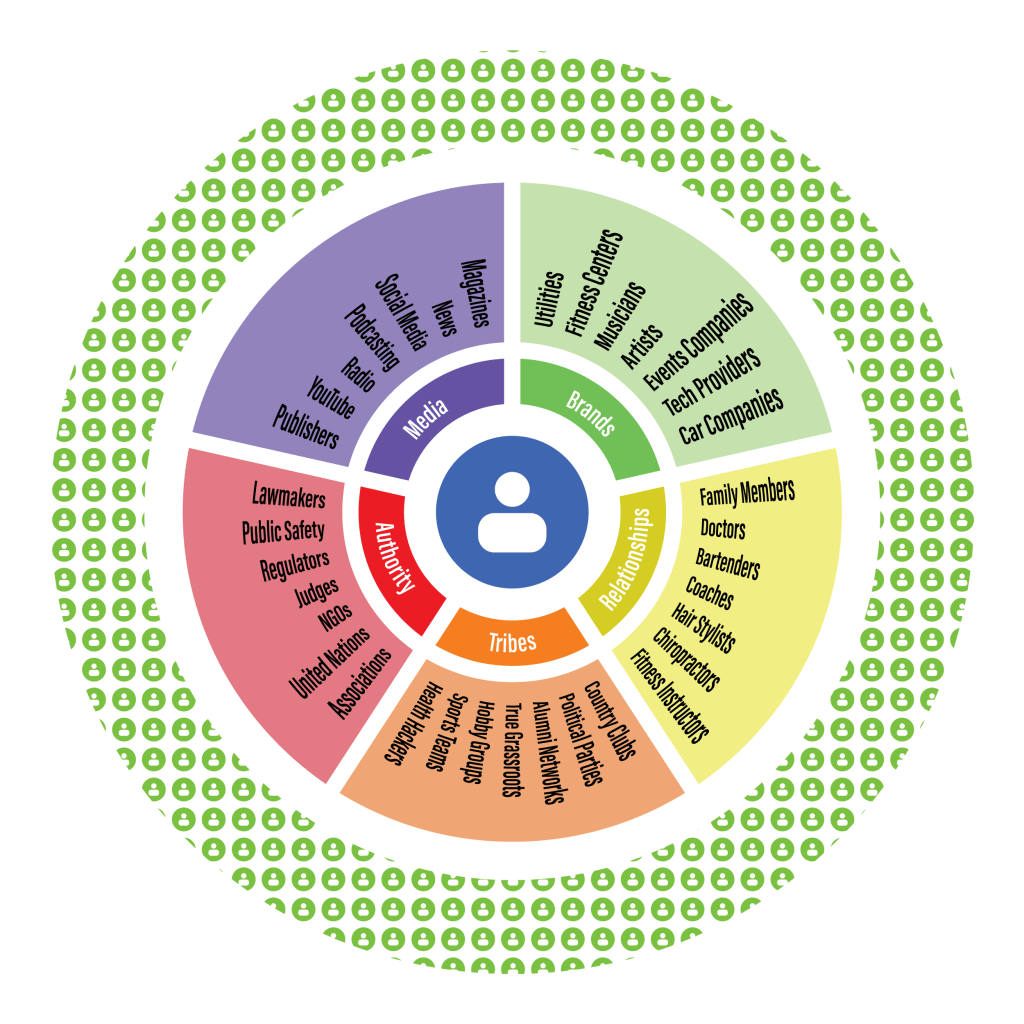
Trust channels are broken into 5 categories: authority, media, brands, relationships, and tribes. I’ve listed a few examples, in each category.
- Authority: lawmakers, public safety, regulators, judges, NGOs, The UN, Associations
- Media: YouTubers, News, Podcasters, Magazines, Radio, Publishers, Social Media
- Brands: Utilities, Fitness Centers, Musicians, Artists, Events, Tech Providers, Autos
- Relationships: Family, Doctors, Coaches, Bartenders, Hair Stylists, Instructors
- Tribes: Country Clubs, Alumni Networks, Hobby Groups, Political Parties, Grassroots
Accessing trust channels via the channel champion
When a trust channel endorses you, the institutional trust built up over decades transfers to you. It’s a quick path to your ICP’s heart but access isn’t guaranteed. You have to bring value to the person or people who control that channel. I call them the “channel champion.”
Some channel champions are straightforward to access. The President of your neighborhood association may require only a phone call to advise her about a new street beautification process you want to undertake. If you are simply aware of the channel, it’s a straightforward ask as long as there’s shared value.
Journalists, editors of respected publications, or YouTubers may require a different approach as they get a constant stream of requests. But, like the President of your HOA, the sample principle applies. Provide value.
The process of exchanging immediate value for trust dates back thousands of years. In 900-1650 A.D., for example, the Algonquian-speaking Virginia Indians would exchange gifts as an immediate show of trust. Failure meant death for the outsider.
Giving value has been, and will always be the fastest way to win trust. But it’s important to define value. Value is defined by others, not you. Those with big ideas will often believe their product or service IS the value. Wrong.
Value is brand-agnostic, not self-focused.
Value Exchange Examples
If your target trust channel is a newspaper, the channel champion would be a reporter or editor. Value is bringing them a great story their readers will click. Journalists are judged by how many readers engage with their work. If someone brings them a story that accomplishes this goal, trust is earned and value is exchanged. The journalist received engagement, and you gained exposure.
Pitching brand-agnostic value is still a great story, even without your brand included. If you can’t think of anything, your story is DOA—journalists don’t write ads.
Value can be broadly defined as well.
In the case of HAIR, the value exchange was altruistic and a shared mission. Because barbers have relationships with their clientele similar to that of a therapist, they naturally want to see them healthy. Dr. Thomas traded value in the form of information to barbers. In exchange, his objective of reaching black men with critical health information was achieved.
Value could be fun.
I’ve had clients invite trust channel champions to fun experiences for the whole purpose of building a relationship.
If there’s no value exchange, the trust channel remains closed.
Podcasts are a rapidly growing trust channel. When a host spends a lot of time in a consumer’s ear, a strong trust bond is created. How would one trade value with an channel champion such as a podcaster?
As an active podcaster for eight years, a live radio host for three, and a journalist for The Washington Post for a time, the pressure to continually find new ideas never ends. If you can bring a host or writer a unique idea and a guest who can communicate, your idea will likely gain exposure.
I utilize the FART method as my method of choice to pitch great ideas.
***
To simplify my entire GTM Foundational process, identify your purpose, shore up your messaging, find your ICP’s trust channels, and provide value to the channel champion.
Integrity and trust is vital. If you lie or deceived, the trust channel collapses.
In the age of Ai, misinformation, shrinking trust, and new media, GTM foundations are built on clarity and trust. There are thousands of trust channel surrounding the audience you seek to impact. And now you have the tools to access them.
Email me if you have questions. contact@JustinKBrady.com
