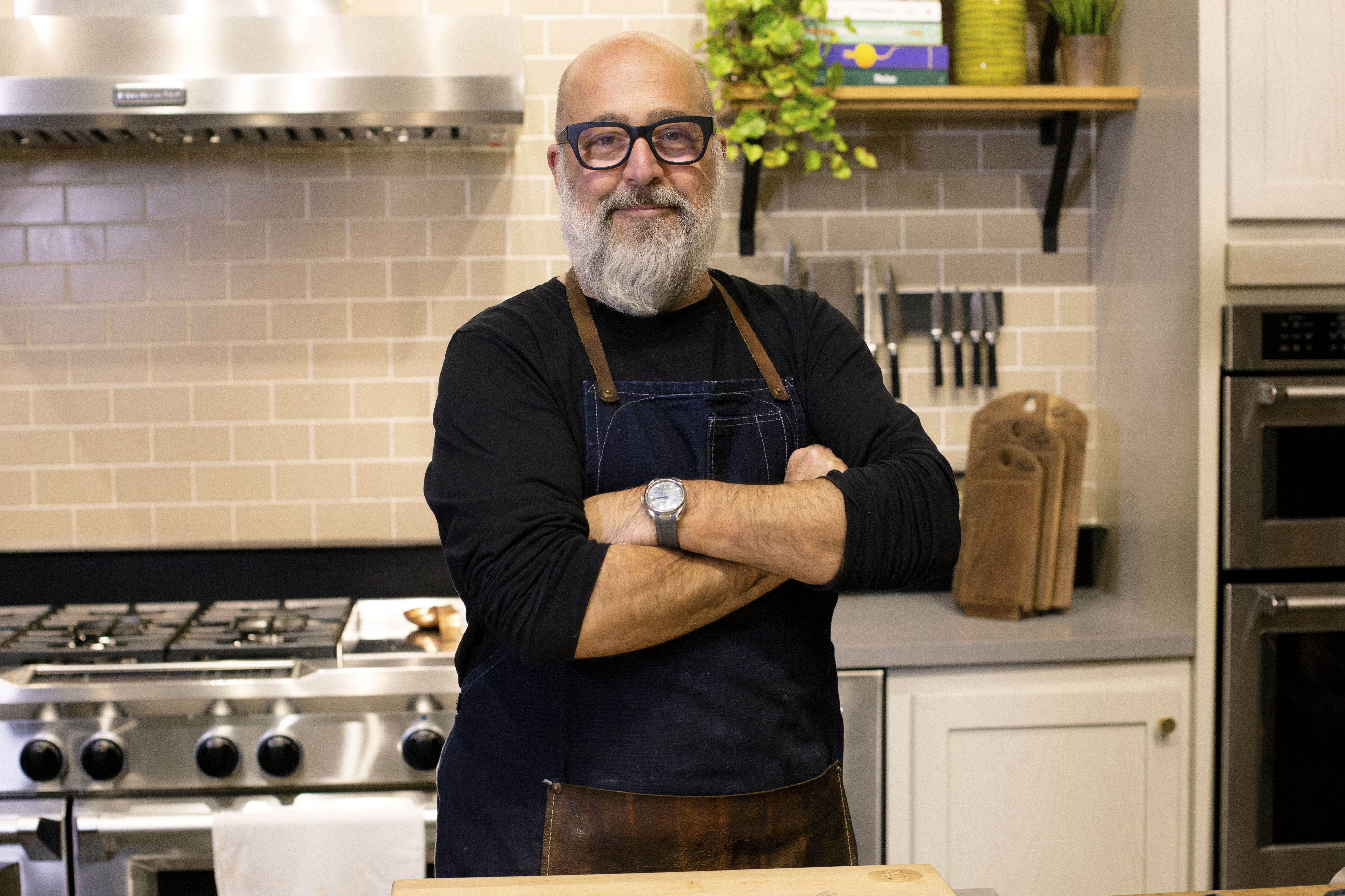
Food Network Star, Andrew Zimmern — A discussion on his secret sauce of interview prep, and why brands are so damn scared to tell stories and create moving content.
The full 40 minute interview is exclusively on Apple, Spotify or right here:



Long before Andrew Zimmern became a household name known for sampling tarantulas and bull testicles, he was a chef searching for a bigger customer base. “It just hit me one day that I needed a bigger audience,” Zimmern recalled. “I wanted to tell bigger stories.” What followed wasn’t a viral video or a flash of luck—as a full grown adult, he decided to take an unpaid internship.
“I got an internship at a magazine, a radio station, and a TV station… I made myself indispensable,” he said. “Before the three months were out, they were all paying me.”
Zimmern’s transition from restaurant kitchens to media spotlight is not the romantic narrative many entrepreneurs cling to. It’s defined not by a single breakthrough, but through humility, combined with a calculated risk. “I didn’t have a choice,” he said, reflecting on his recovery from substance abuse—he had to pivot. “The ‘80s were a missing decade for me. I sobered up in January of ’92. I was starting over.”
That willingness to start from scratch—and embrace uncertainty—is a theme that carries through Zimmern’s journey. “There are a lot of people that are smarter than me, funnier than me, better looking than me,” he said. “One thing I did that other people weren’t doing was that I saw something with clarity for a brief moment and I ran at it.” That impulse—acting decisively when clarity strikes—would become both personal ethos and professional compass. “Don’t think about it too long. Run for it. If it doesn’t work, it doesn’t work.”
Why video is so hard — the audience decides
Zimmern is refreshingly realistic about the brutal ambiguity of success in media. “None of us have control over how the audience is going to receive us,” he said. “Will people tune into you on Tuesday night at nine o’clock? Will they come back next week—and the week after that?” It’s a rare humility in an industry that often confuses talent with entitlement.
He attributes much of his longevity to one hard-to-quantify quality: authenticity. “I’m just myself. I’m the same person talking to you that I am when the cameras are on,” Zimmern said. “There are other people even on the food side of things who are not the people that you see on camera.”
That authenticity becomes especially potent in unscripted, emotionally charged formats like Family Dinner a show on Magnolia Network where Zimmern eats with families across the country, sometimes navigating intimate, even painful, conversations. “You do visually see me getting into tears at times,” he acknowledged. “Some of this stuff is really heavy.”
But how does one prepare to interview everyday people—many without public bios or media training—and coax out meaningful stories? The secret, Zimmern says, isn’t in research but in presence.
“I tune everything out and I just listen to what they’re actually saying,” he explained. “I try to remember one or two important pieces of each person’s story… and go down the road they offer.”
How Zimmern preps for interviews, but keeps it natural
While Zimmern disavows over-prepping, there is method in the looseness. His team conducts pre-interviews and even scouts dynamics in person. They brief him before shoot day, but are careful to share too much detail so as not to spoil certain surpirses. This is a key part of his interview style, and as a professional interviewer myself (Justin here 👋) it’s the key component I was dying to know. Mystery solved.
Once filming begins however, there are no notes anymore. He lets instinct take over, pulling from only his the background he has fully synthezied from his team.
“I had to wait for the right moment,” he said, describing an episode featuring a family of pastors. It wasn’t going amazingly well. “I remember thinking, ‘well, thank God for editing…’ and then someone said the word ‘belief.’ That was the door.” One word triggered something.
The moment yielded a powerful exchange. “I said, ‘Wow, you guys really seem to believe in believing… it looks like blind faith to me,’” he recounted. “And six heads just went like this.” He gestured, looking up. The group’s attention was the permission he needed to go deeper.
Listening is key, but hard
Zimmern doesn’t just listen—he interrogates contradictions. “If you’re talking about how much you love your wife, I’m going to ask you about your worst fight,” he said. “If the road is flat, that’s boring. Go deep.” If you haven’t picked up on the pattern, he listens intently to words and context, always searching for openings. Or in some cases, areas that are closed off.
Sometimes that means isolating subjects away from the group dynamic. “I realized that the show was going to be so boring,” he said about a particularly harmonious family. “I needed to get one of these family members alone.” In a standout scene, he interviewed the family’s Russian-born mother as she prepped dinner. “I just made the whole interview about what was in the suitcase,” he said. The segment became one of the most moving in the series.
“You can’t have fear when interviewing,” Zimmern emphasized. “I asked her: ‘Did you love him then, or did you fall in love once you got to America?’”
Improvising with poor resources, made him better
His formative years in live local news in Minnesota gave him the resilience and improvisational chops to thrive under pressure. “Live local radio and news is the best university-level education,” Zimmern said. One Halloween, he was sent to a corn maze at 4:30 a.m. with no lighting and no plan.
Slightly concerned he asked the station management what they expected out of him with no resources. They told him to make it work. And boy did he.
“My first hit was me holding the light under my face like the Blair Witch Project,” he laughed. “I didn’t want to interview a goose. But we made it work.”
These early experiences weren’t glamorous—but they were formative. “You learn to be very creative and make something from nothing.”
Food is the conversational jump-off point
Zimmern’s enduring fascination with food is less about taste and more about context. “Food is probably the best telescope through which to view anything,” he said. “It’s a cultural pillar that trumps all the others.” He believes that food can be a gateway to deeper understanding—of history, trauma, identity. “Take someone’s mixtape, you might get a punch in the nose,” he quipped. “But when you take away bread and rice, that’s when blood runs in the streets. That’s what revolutions are made of.”
Still, he acknowledges that other cultural hooks can serve similar purposes—music, fashion, even hardware. “If I had worked in a hardware store my whole life, I’d do it through hardware.”
Where brands fail: they’re afraid of story
Zimmern sees a pervasive failure among brands: a fear of storytelling. “They’re afraid to,” he said bluntly. “Brands being afraid to tell their story—or seek out the wisdom of experts to help them—is probably the biggest mistake I see.”
Ironically, he believes the rise of AI might be a helpful push. “It’s scared people so much it’s got them invested in [content],” he said. The best brands—he cites GANT and a Brooklyn coffee shop—are already producing episodic storytelling that works.
“You can tell stories in 30 seconds,” Zimmern insisted. “Two people disagreeing about something makes a great story. Just start with a hook. I bet you don’t like beef stew.”
For him, the future of branded content isn’t in polished ad copy—it’s in narrative authenticity. “Even if you have a minute, you can make a series with really, really interesting 1-, 2-, 3-minute segments.”
And if there’s a final lesson Zimmern offers—for founders, creators, or just anyone hoping to be heard—it’s to stop waiting. “Most of the things we try don’t work,” he said. “So why not just run at the thing?”
Get more Zimmern!
Check out Andrew’s three-part docuseries Hope in the Water. The series, focused on ocean sustainability, earned nominations for a News & Documentary Emmy and a James Beard Media Award.
Also check out Hope in the Water: The Blue Food Cookbook, releasing October 28, 2025. He currently hosts Andrew Zimmern’s Wild Game Kitchen and Field to Fire. Zimmer hosted the 2025 James Beard Restaurant and Chef Awards on June 16 in Chicago.
