
As Apple celebrates 20 years of podcasting and TIME Magazine‘s 100 “best podcasts of all time” list releases, podcasters are having their moment, but how much of it is real? I ask this question, because I cheated Apple’s top 200 business list.
Most people would assume the Apple Podcast “top” lists earned their way into the list by attracting listeners. But this isn’t the case. Anyone can appear in these lists, for less than the cost of most digital advertisements.
How to get in Apple Top Charts by cheating
My experiment started January 6th, and by the 13th I hit 191 on Apple Business list. This Podcast Isn’t Real cracked the coveted top 200 with a measly 1025 downloads, hitting 158 with 4,300 downloads thirteen days later. Had I pulled a few more “levers” it would have hit the top 10.
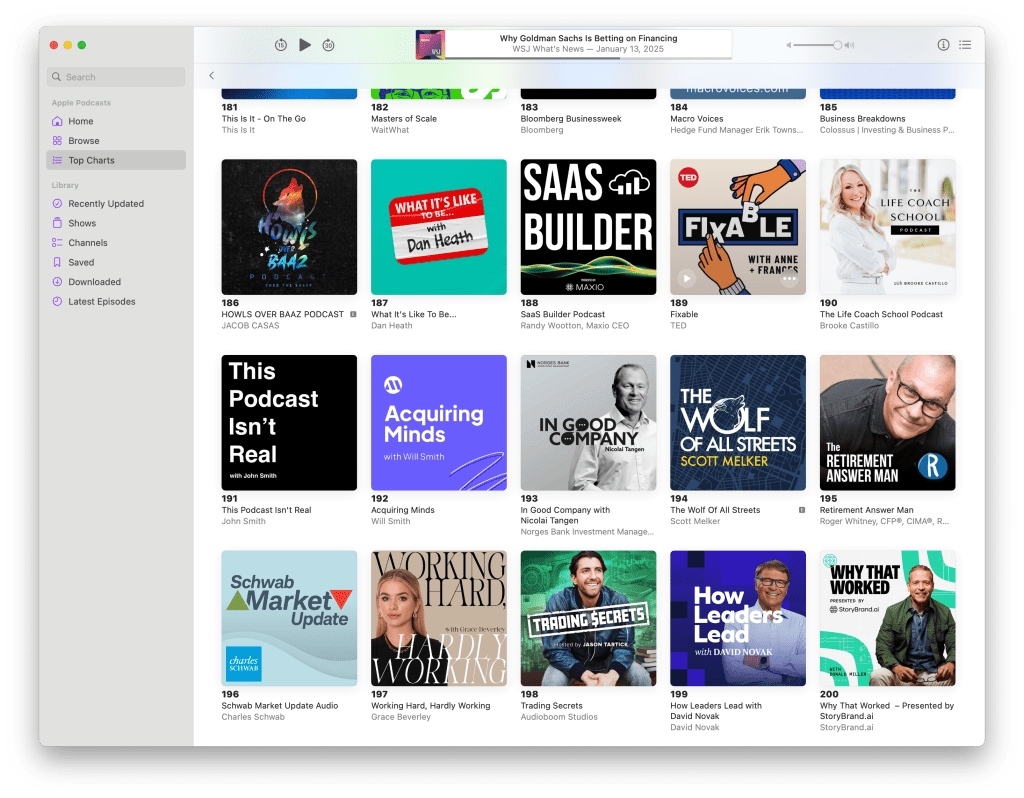
As a PR guy, I’m aware of the tactics brands use to buy fake engagement online. This is why I teach inventive founders how to measure their marketing and PR. The numbers never tell the full story. Sadly, many lose focus and in effort to reach customers, fall into a dark industry of fake engagement.
You can buy fake social media followers, fake web traffic, fake livestreamers, fake comment bots and yes, cheating the Apple Podcast “top” lists.

Because I’ve interviewed Presidential candidates, CEOs of Fortune 500 companies, and YouTubers with one million subs on my podcast, I’m routinely messaged by people selling services. One category stands out. They call themselves “podcast promoters,” “podcast marketers,” or “podcast growth experts.”
I’ve been watching this industry for years, trying to build trust with a few “promoters” in the industry. Over time, a few have slowly named dropped large shows they’ve worked with, providing message transcripts in some cases, but I had no idea how to prove these “promoters” could actually fulfill their promises.
So, I decided to put those claims to the test by making a completely fake show. This Podcast Isn’t Real, hosted by John Smith.
I responded to a promoter who messaged me on X. “Hey Justin Brady, Master of the Mic! 🎤🔥Hope you’re rocking it as always! Quick question: do you have your podcast on Apple or Spotify? Can’t wait to hear back from you!” Game on.
He quoted he could get my show in the top 200 for $500, sent via PayPal. Starting with a down payment of $250, he delivered. Not only can anyone buy into the “best of” lists, but it was fast, relatively cheap, and the threshold to hit the top 200 is far lower than most realize.
But before I paid my remaining balance, I offered him a bonus if he told me how the scam worked.
How “podcast promoters” work
I learned the days of massive click farms and huge racks of devices are over. Today, “promoters” have found a way to utilize multiple Apple IDs on a single device. In his case, we uses fewer than 30.
I also learned there’s a market for Apple IDs; they sell for as little as $7 a pop and can be purchased in bulk from brokers. To avoid detection, he uses a VPN so the traffic doesn’t originate from his home country or city.
It would appear Apple has no way of countering or detecting this fraudulent activity. In fact, they seem to be having trouble presenting accurate data at all. During this experiment, I noticed large discrepancies between host data, in my case Libsyn, and Apple’s own “Podcast Connect” tool.
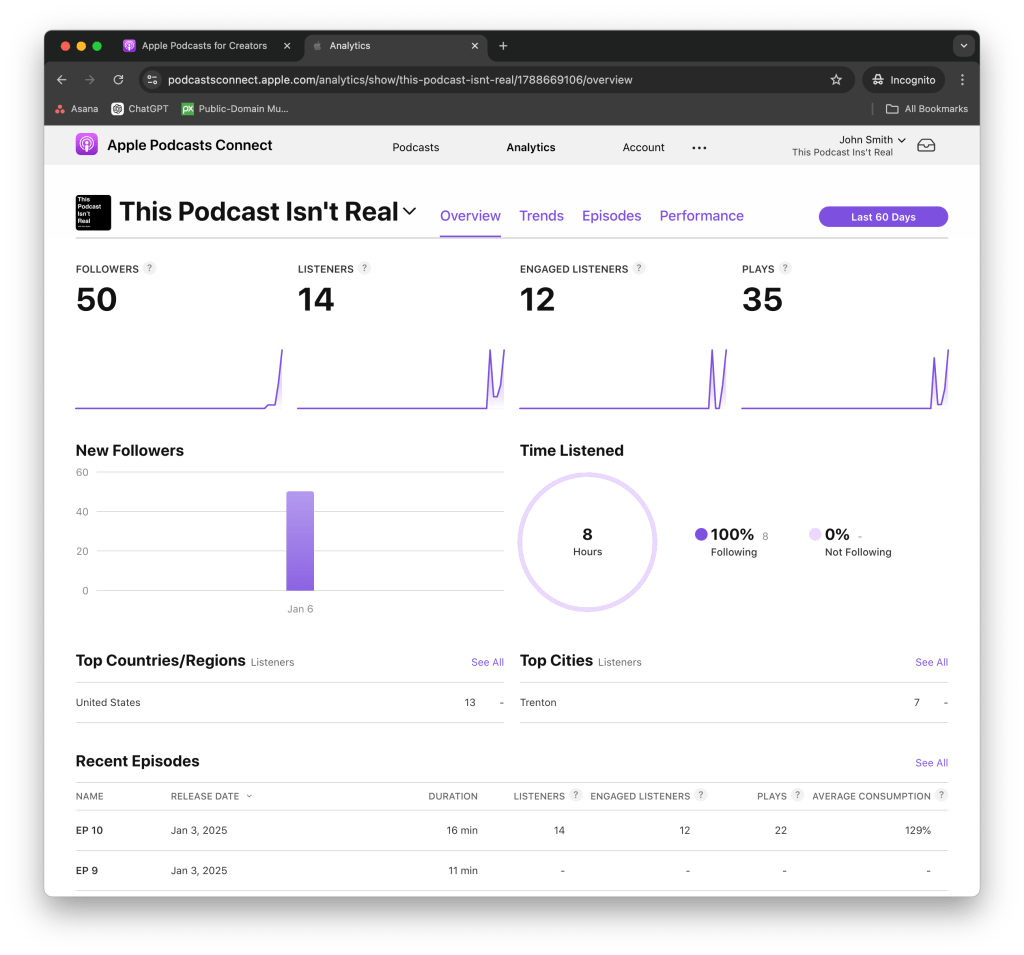

On January 13th, when the show cracked the top 200 the server data, showing how many times a show has been downloaded and from where, didn’t match Apple’s own “podcast connect” data. This means, when someone downloads a show, Apple may or may not document it every time.
At the time of my screen capture, Libsyn showed I had 1018 downloads, but Apple showed 35 plays, 12 “engaged” listeners, 14 total listeners, and 50 followers. While it may seem as though Apple is discounting what may be “fake” listeners, that doesn’t explain why the show hit the top 200 with 35 total plays.
Apple is undoubtedly aware of this issue. Do they not know how to solve it? Do they want to solve it? Do they somehow benefit from inflated traffic on Apple Podcasts in some way?


Why are podcasters doing it?
I’ve slowly worked on this story for years, exchanging DMs with various “promoters” in hopes to learn more. Some block me, some give me the runaround, but some have shared names of creators in an effort to get me to work with them, even going as far to show messages and receipts. Many of the shows were in Apple’s top 20. Some still are. The person I worked with even claimed to work for a major media brand to promote their show.
I’ve also reached out to a few of these podcasters to determine why they would hire a promoter or if they had knowledge of the process. Most haven’t returned messages or emails. One had their assistant respond to me, giving me non-answers and strong denials for questions I didn’t ask.
A few motivations come to mine: vanity, inflated advertising revenue, influence, and the sneakiest one of them all: a cheap form of digital advertising.
Charging higher advertising revenue is a clear motivator, but influence is a clear motivator. It’s easier to get high profile guests and new connections. Locking down big names on a show can yield other big names.
“Popular” shows also attract real listeners. People use social proof to quickly determine if content is good. If it’s popular, people will listen. This is why some live streamers use “seeding” or view bots to pump their livestream numbers, as was the case for a recently busted Twitch streamer.
Fake engagement can also close client relationships, sell books, and close big opportunities, but it could also be a clever digital advertising hack.
Considering Apple Podcasts has roughly 250 million active users and 22% (55 million) find new shows via its lists or recommendation tools. Buying your way into the Apple Podcast lists cost me only $500 for about 30 days. Roughly, Google Ads would cost $171,600 at a CPM of $3.12 and Facebook Ads would cost $700,700 at a CPM $12.74.
Also consider what else you could do with fake Apple IDs. You could position apps into the top charts as well—more free advertising.
It’s important to point out however, it is possible some creators and podcasters benefiting from fake engagement could be victims. These “promoters” claim to promote your show to “real” listeners. If numbers are going up, a creator might not question their methods. But whether they’re innocent or guilty, the implications are significant—this could constitute fraud.
If advertisers spend money on a fake show or brands partner with creators, this issue could go beyond an ethical or moral concern, but a legal one. Some podcasters charge for appearances, which could also be problematic from a legal standpoint.
If we stop the story here it’s a fairly crazy revelation. For $500 or less, anyone can get their podcast in the top 200 in about 1 week. If you think this is big news, I would agree.
I worked alongside a reporter on this very story. I told her of my experiment, and pulled it off as she watched. She was excited, asking me to keep it exclusive to her saying “I’ve already written this story in my head.” But something changed.
After running it up the food chain, she tabled it finally texting me, “I am not comfortable with being part of your story. In any way.” Pitching it to yet another reputable publication, I again got initial excitement, but hit a brick wall after the journalist ran it up their own food chain.
It could be nothing. It could be that Apple is a major advertiser. It could be both these publications currently have podcasts in the top 200.
I may never know, but here’s what I do know. Founders and marketers, be careful who you partner with. Make sure results drive decisions.
